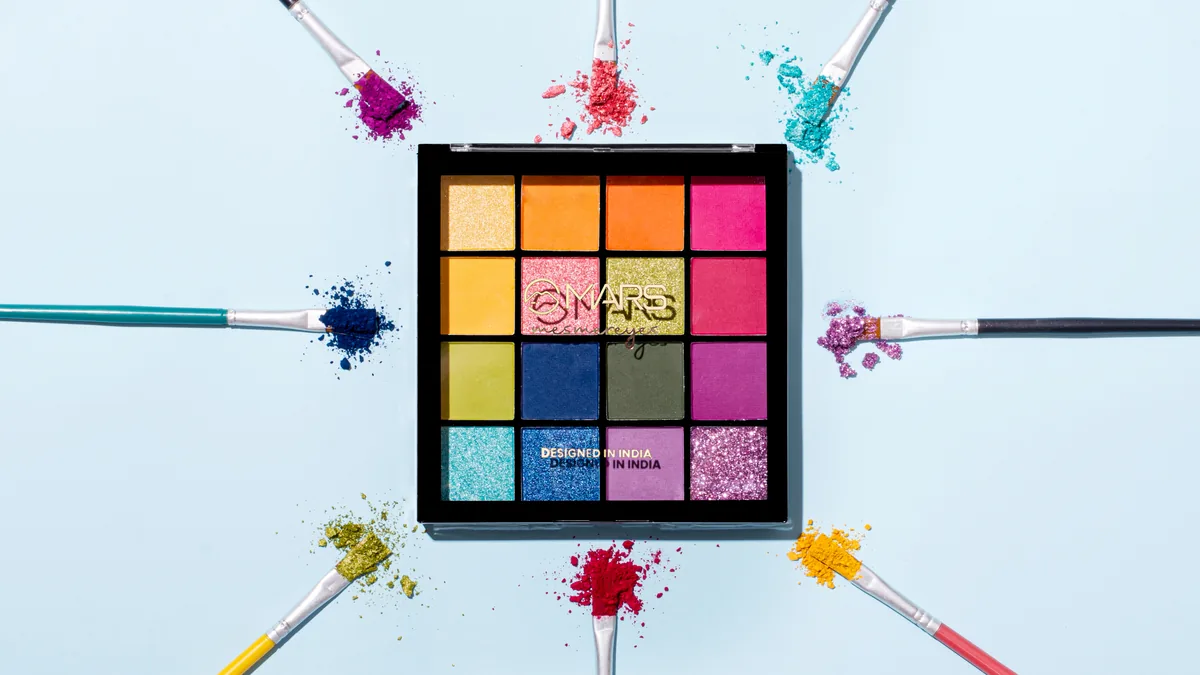
Our range for product photography is Rs 500 to Rs 1,500 per image. Cosmetics and skincare sit in the upper half of it more often than most categories, and the reason is almost always the packaging rather than the product.
Why beauty products cost more to shoot
Beauty packaging is designed to look expensive on a shelf, and the same qualities that achieve that make it slow to photograph. Glass, gloss, foil, metallic caps, frosted finishes and clear liquids all behave badly under lights.
A matte cardboard box reflects almost nothing, so it can be lit quickly and the shot is close to finished in camera. A glass serum bottle with a metallic pump reflects the softbox, the room, the ceiling, the tripod and the photographer. Getting a clean image means controlling every one of those reflections, usually with flags, polarisers and a lot of small adjustments.
That is time on set, and time on set is what you are actually paying for.
The categories inside the category
Not all beauty products price the same way, and it is worth knowing where yours falls before you compare quotes.
Cartons and tubes are the easiest. Matte or lightly coated packaging, simple shapes, quick to light. These sit at the lower end of the range and batch well.
Glass bottles and jars are the middle. Reflections and edge definition take real work, and clear or coloured liquid inside adds another problem because it refracts whatever is behind it.
Metallic, foiled and mirror finishes are the slow end. Compacts, lipstick cases, anything chrome. Expect these to take several times longer per unit than a carton.
Swatches and texture shots are their own job. Cream on a surface, a lipstick drawn down, powder broken open. They need styling, they are messy, and each attempt usually ruins the product, so budget product units as well as time.
The line most brands forget to ask about
Retouching. Beauty is the category where the gap between a raw frame and a finished image is widest, and it is also where studios most often quote the shoot and leave retouching vague.
Cosmetic retouching normally includes removing dust and fingerprints from glass, evening out reflections, cleaning up label edges, and matching colour across a range so your listing does not look like it was shot on five different days. On a shade range that colour matching alone can take longer than the shoot.
Ask specifically what level of retouching is included, how many revisions you get, and what happens if the colour comes back wrong. A quote that covers the shoot and bills retouching separately is not cheaper, it is just less clear.
Shade ranges change the maths
If you sell a foundation in twenty shades or a lipstick in fifteen, you are not shooting one product. You are shooting a set that has to look identical in every respect except the colour, which means one lighting setup held constant across the whole range and colour accuracy checked against the real product.
This is where per unit pricing works in your favour, because the setup is built once and the marginal cost per shade is low. It is also where cheap photography shows up worst, since a shade range that drifts in colour across the listing looks careless in a way a single product never does.
What to check before you book
Ask how many images per product the quote covers, whether swatch or texture shots are included or extra, what retouching level is included, and whether they have shot reflective packaging before. That last one matters more than the portfolio being pretty. Ask to see a glass bottle or a metallic cap specifically.
The general breakdown of product photography costs in India, including the per image and per product tiers, is in our pricing guide. At the other end of the size scale, furniture is priced on space rather than per item, which is a useful contrast if you are shooting a mixed catalogue.